 NE TO BETTER
Nagi-dō: Building a Little Stillness
One to Better — Build Notes
Sometimes the smallest part of a project becomes the project.
I wasn’t planning to build a meditation app.
I was working on a workout app and added a simple meditation timer. Nothing particularly ambitious. Just something to help me sit quietly for a few minutes.
I’ve meditated since 2017. For most of those years, Headspace was my companion, and I loved it. But over time it grew, as apps tend to do. More features, more choices, more things to tap before I could simply sit down and breathe. Opening it began to feel like a small decision. And then another.
So as I worked on that little timer, I kept coming back to it.
I started adding things. A breathing orb that gently expands and contracts. The sound of a singing bowl. Rain, ocean waves, and a few other sounds that made the experience feel a little more peaceful.
Eventually, that small feature became more interesting to me than the app it was part of.
So I gave it a name.
The way of stillness
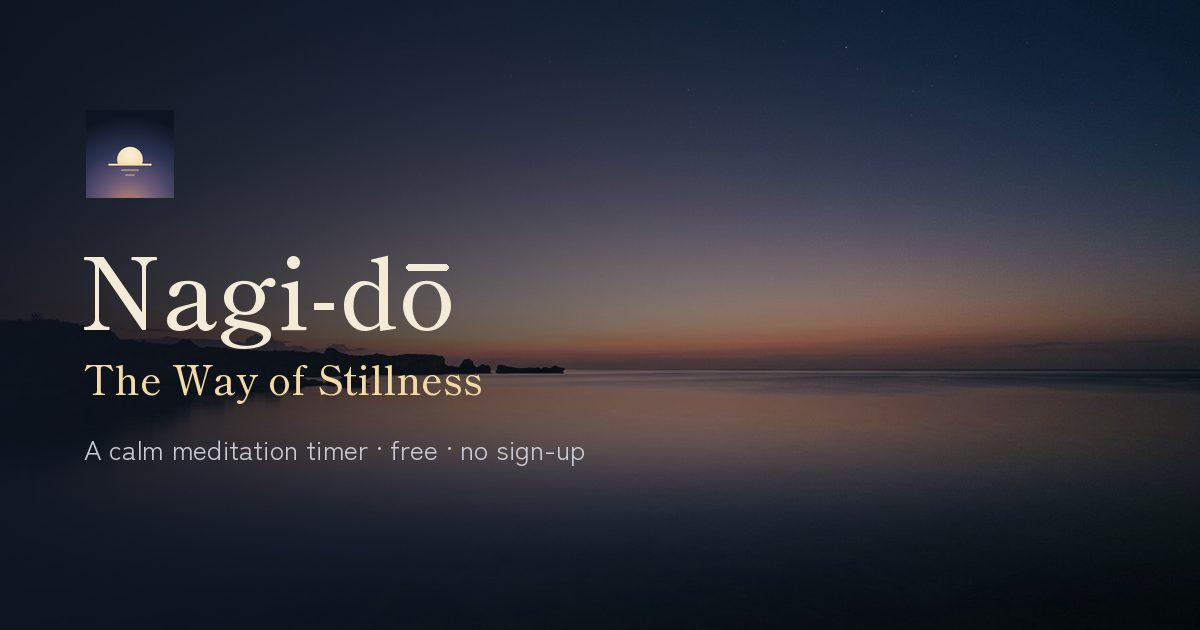
In Japanese, nagi (凪) describes the moment when the wind drops and the sea becomes still. Dō (道) means “the way,” as in judo or kendo.
Together, Nagi-dō became my little interpretation of the way of stillness.
I’ve lived in Japan for many years, and I’ve always appreciated how the culture can embrace both extraordinary energy and quiet simplicity.
I wanted the app to reflect a little of that.
Open it. Choose a time. Sit.
That’s really all it needs to do.
Knowing when enough is enough
One of the interesting things about building software with AI is how easy it has become to keep adding things.
Another feature? Sure.
Another screen? Why not?
Before long, something that began as a simple idea can become unnecessarily complicated.
And I think that’s one of the challenges of AI-assisted development. Just because we can build something doesn’t necessarily mean we should.
With Nagi-dō, I wanted to resist that temptation.
There are guided breathing exercises, gentle ending bells, background sounds, a daily quote, and a simple way to see your progress over four weeks.
But no accounts, no social feeds, and no guilt-inducing reminders about breaking a streak.
It does keep a streak, and I kept that on purpose. A streak doesn’t make me calmer. The sitting does that. What the streak gives me is a quiet sense of accomplishment, and a gentle reason to show up again tomorrow.
The app doesn’t need to know who you are.
It doesn’t need to compete for your attention.
It just needs to be there when you want it.
Building with AI
I built Nagi-dō with Hark Pro, an AI agent that helped with the design, code, sounds, voice, and countless little revisions.
Underneath, it’s remarkably simple:
- One file. HTML, CSS, and JavaScript in a single page, without a framework.
- A Progressive Web App. You can add it to your phone’s home screen and use it much like a native app, without going through an app store.
- Your data stays on your phone. Your minutes and streak are saved on your device, not on a server.
- Sounds and voice by ElevenLabs. The bells, the background sounds, and the gentle voice guide were all generated there.
- Code on GitHub, hosted on Cloudflare. Every change goes to GitHub, and Cloudflare serves it at nagi-do.com.
There’s something satisfying about that.
We’ve reached a point where someone with an idea, a little curiosity, and a willingness to experiment can create tools that once would have required an entire development team.
But AI doesn’t make the decisions about what is worth building.
That’s still our job.
A little irony
I recognize the irony of building an app for a device that is probably responsible for a good portion of the distractions in our lives.
We carry these remarkable little computers everywhere, and most of the software on them is designed to keep us engaged.
Nagi-dō is an attempt to do the opposite.
Use the technology for a few minutes, then forget about it.
Maybe that’s a useful way to think about good technology. Not how much of our attention it can capture, but how well it serves us without demanding more.
One to Better
I don’t know how many people will use Nagi-dō, and I’m not particularly concerned about it.
It’s free. There’s nothing to buy, no account to create, and no business model hiding behind it.
I built it because I wanted something like it to exist.
Along the way, I learned more about building with AI, designing for simplicity, and recognizing when a small idea deserves to become something of its own.
And perhaps that’s the lesson in this particular project.
Improvement doesn’t always mean adding more.
Sometimes it means removing everything that doesn’t need to be there.
Sometimes, better is simply a little less.
Stillness is priceless, and Nagi-dō is free. Open nagi-do.com, set it for three to five minutes, and just breathe. Notice how you feel a little better. That’s the whole trick: a little, done consistently, is priceless.
Built with: Hark Pro · HTML · CSS · JavaScript · ElevenLabs · Cloudflare · GitHub
One to Better
Better is a direction, not a destination.